 Whether you call it laid off, downsized, or losing a perfectly good position you love, being told you no longer have a job is not fun.
While not totally preventable. it is possible to do things, or not do them, to lessen your chances of making the expendable list. [Read more…]
 I always enjoy spending time with my sister Judy. I admire the way she lives her life. A successful CEO, loving partner, and a person who can have a serious amount of fun. She has a vision of the way she wants to live her life and fills her world with people who enhance rather than diminish her. It is very planned and directed. One of the reasons she has achieved so much.
  Interested in knowing my coaching client’s number one complaint? Too many work hours? No, though many do work a tremendous number. Too little pay? Think again. Crazy boss? You are closer. People’s dissatisfaction is based on a desire to be recognized for what they do and how they do it. Doesn’t seem to matter if the
  So many of my clients tell me it’s easier to do than delegate. “It’s faster, Jane, and cheaper” some say. I believe you, sort of. The great part about doing everything yourself is the sense of control you gain and the rush you get from crossing all these tasks off your “to do” list. The problem is the list keeps growing and you continue to address only immediate needs. The next thing you know you’re 100% up on the tactical and nowhere with strategy. It’s a matter of learning how managing yourself leads to your success.
 Money is tight everywhere. Even people doing well are feeling the impact of local, national, and global slowdowns in the economy. That said, it doesn’t necessarily mean no one is getting merit increases, promotions, and salary adjustments. Whether you work for a company that has a very structured compensation review process or are employed in a more entrepreneurial setting where salaries are handled in a less formal manner, you have to have a strategy and approach to making sure you are getting what you have rightfully earned without jeopardizing what you have.
  How does a company, firm, or individual determine if they have, want, or are striving toward the competitive edge? Questioning “what is professional success?” is a good first step. For many, the easy answer is money and status. But, when these are attained (or lost) it is surprising how ethereal they were. On the other hand, if success has more to do with an ability to express oneself and be heard, engage with a passion and interact with equally motivated people, then the target moves. Whatever the definition becomes, it is clear that to acquire the edge and remain competitive takes risk.
 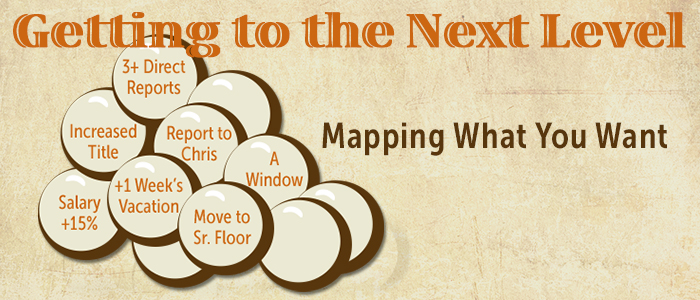 I’m fortunate to have a diverse group of executive coaching clients. Although why they come to coaching may be similar, such as accelerate their career goals, workplace issues, and challenges with leadership and managing people, their expectations and stated outcomes are always varied. By necessity coaching has to be customized; never relying on any sort of template to suit everyone. Never, until I was introduced to the grape cluster.
  Executive coaching clients wanting to enhance their role and impact in their current workplace continuously ask me, “How do I get greater recognition?” “Make sure my boss doesn’t get all of the credit?” “What’s the best way to be found by potential employers and thought leaders in my field?” My answer is often “branding yourself.”
  It shouldn’t surprise me anymore, but it does. When a potential coaching client contacts me, I often ask two questions, “How did you find me?” and “What made you interested?” Ninety percent of the time, the answer to the first question is “I Googled ‘career coach.” No surprise, I work hard to make it easy for people to find my business and me. It’s the second answer that’s shocking, “Well you were the only person who called back.” What? My colleagues are spending considerable time and money grabbing the attention of potential customers and when they do get someone’s eye, they fail to respond? It’s shocking, but good for my business.